


Calling for a stop to demolitions and demanding a resettlement plan, more than 100 residents of Taipei’s Huaguang Community (華光) and their supporters clashed with police as a demolition squad moved in yesterday to tear down two houses as part of a development project.
“No to forced eviction. We want resettlement,” protesters shouted as about 300 police officers escorting the demolition squad moved into the community at around 10:20am.
They had set up a 3m tall tower in front of the houses scheduled for demolition, while more than 100 people lay in front of the houses. Inside the houses, students chained themselves to walls and doors.
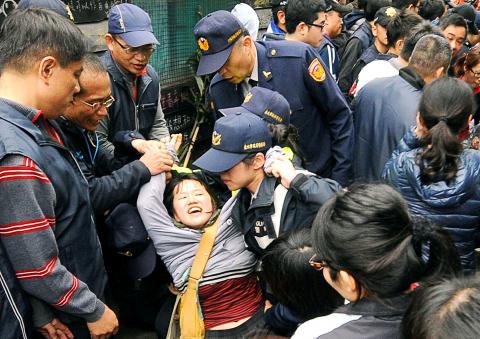
Photo: Wang Min-wei, Taipei Times
The situation quickly became heated when the police started to take protesters away.
“How could you do this to these people? Do you have a heart?” a female protester yelled.
It took police more than two hours to clear the street in front of the houses.
Soon after the police broke into the houses, arresting more students.
“You should have female police officers to do the job,” protester Lin Fei-fan (林飛帆) yelled at male officers grabbing female protesters inside one of the houses.
“We don’t have such a good service,” an officer said, to which Lin responded: “Asshole.”
Enraged, the officer slapped Lin in the face and yelled: “What did you say? I dare you to say it again!”
“I don’t know what I did wrong to be treated like this,” Lee Kui-chu (李桂朱), a Huaguang resident, said in tears after being forced from her house. “I feel very sad and sorry to see so many students supporting us being hurt by the police.”
“Life is already hard for us, now that our house is flattened we will just have to find another place to live, while the bank accounts of the entire family have been frozen due to the lawsuit over ‘illegal occupation’ of government property,” another resident Lin Su-hua (林蘇華) said.
Heavy machines moved in to accelerate the demolition after all the protesters — many of whom went on to launch another protest in front of the Executive Yuan — were removed by about 2:30pm.
The Huaguang community, located near Chiang Kai-shek Memorial Hall in the heart of Taipei, is mostly inhabited by former soldiers — and their descendants — who withdrew to Taiwan with the Chinese Nationalist Party (KMT) after the Chinese Civil War.
Although the land was officially government property, the soldiers were unofficially allowed to live on it as the government at the time was unable to address housing shortages. Their homes were subsequently given official house numbers, electricity and water were provided, and taxes were collected from them.
However, when the government decided to use the site for a commercial development more than a decade ago, residents were asked to leave, and then sued for “illegal occupation” of government property.
Residents have staged a series of protests, but despite President Ma Ying-jeou’s (馬英九) promises, no resettlement plan has ever been drawn up.

UPGRADE: The Kang Ding-class frigate is replacing its Chaparall missiles with Tien Chien II and Hua Yang VLS, which would provide it with long-range, 360° air defense Taiwan plans to produce 1,200 to 1,376 Hai Chien II missiles (海劍二, Sea Sword II) — also known as TC-2N — to serve as the standard air defense system of the navy’s surface combatant fleet, a source said yesterday. Last week, the Hai Chien II, the naval version of the Tien Kung II missile (天劍二, Sky Sword II), completed a live-fire test in waters off the National Chungshan Institute of Science and Technology’s Jiupeng facility (九鵬) in Pingtung County’s Manjhou Township (滿州). The MIM72 Chaparral and other dated air defense missiles that currently arm Taiwanese ships have inadequate range to combat Chinese

REASONS FOR TRAVEL: An assistant professor said that proposed amendments to penalize drivers if they used drugs overseas would not deter people from traveling People who operate a motor vehicle under the influence of marijuana would have their driver’s license revoked, even if they used the substance while overseas, the Ministry of Transportation and Communications said yesterday, citing proposed amendments to the Road Traffic Management and Penalty Act (道路交通管理處罰條例). The amendments would also authorize the government to revoke the licenses of people determined to have used Category 1 or Category 2 narcotics, even if they were not operating a vehicle while under the influence of drugs, as well as ban them from taking the license test for three years, the ministry said. People aged 18 or

HEAVY WEATHER: Typhoon Jangmi is due to crash straight into the Ryukyus as airlines look to shift flights to larger aircraft or cancel flights to Okinawa entirely Taiwan’s international air carriers announced flight adjustments over the weekend as Typhoon Jangmi is forecast to hit the Ryukyu Islands today and tomorrow. The Central Weather Administration (CWA) upgraded Jangmi from a tropical storm to a typhoon at 8am yesterday, with the eye located 580km south of Naha city. It was moving north at 19kph. Today, China Airlines’ CI-120, CI-121, CI-122 and CI-123 flights between Taoyuan and Naha, Okinawa, have been canceled as well as CI-132 and CI-133 between Kaohsiung and Naha. EVA Air’s BR-112, BR-113, BR-186 and BR-185 flights between Taoyuan and Naha are also canceled. Low-cost carrier Tigerair Taiwan canceled IT-230,
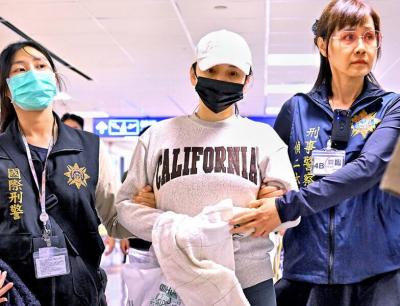
Johanne Liou (劉喬安), a Taiwanese woman who shot to unwanted fame during the Sunflower movement protests in 2014, returned to Taiwan last night after being deported from the US. She is to stand trial in Taiwan for charges involving embezzlement, fraud and drug crimes. The Criminal Investigation Bureau (CIB) said it took her into custody at Taiwan Taoyuan International Airport and would first question her before transferring her to the New Taipei District Prosecutors’ Office. She was arrested upon disembarking a flight from San Francisco that landed shortly before 7pm. Liou absconded to the US in 2019 after jumping bail


 RSS
RSS